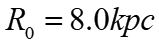
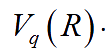
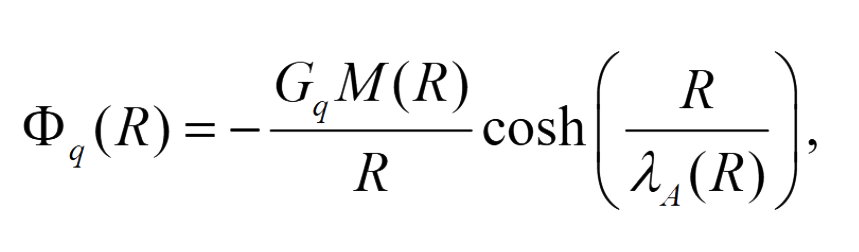
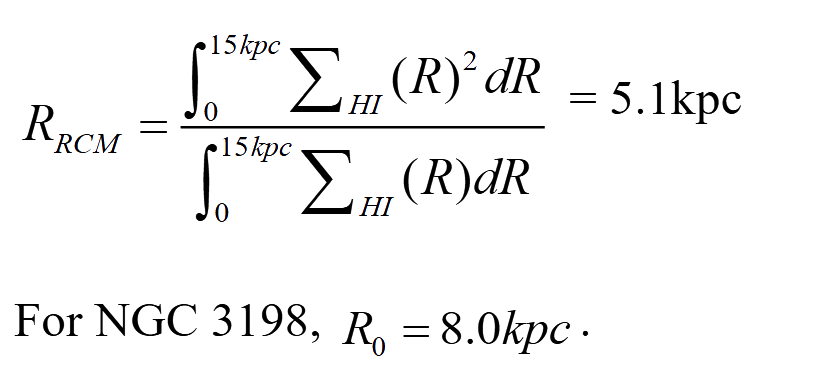
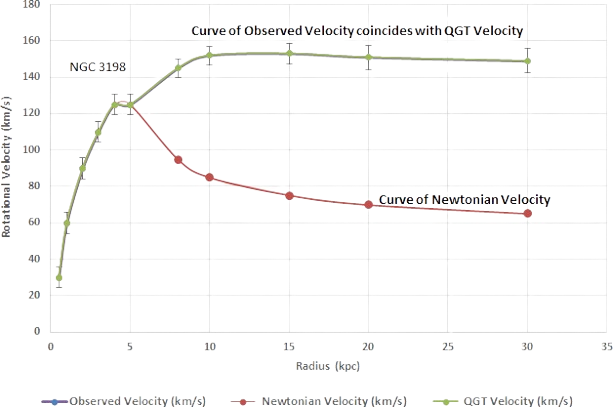
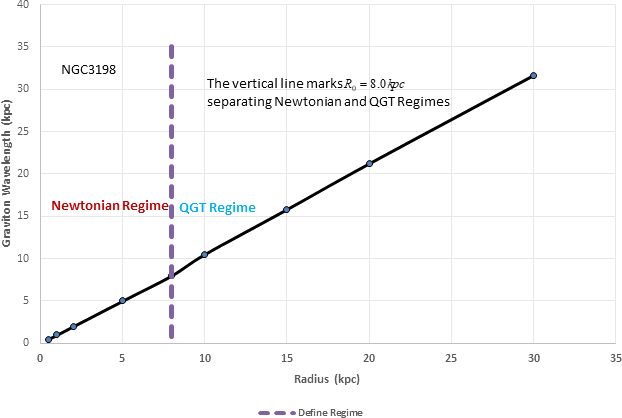
2)QGT’s success in NGC 3198 parallels its validation for NGC 6503 (Begeman, K.G. 1987) (Wong et al. 2014), suggesting universality.
3)Future work will extend testing the universality of QGT across galaxy types (Dwarf Vs Spiral).
Acknowledgement
The authors are grateful to the anonymous referees for their valuable comments. They also thank for the assistance and encouragement from Janice Kim-Kiu Cheng and George Shun-Kwong Ma during the preparation of the paper.
References
[1] Begeman, K. G. (1987). *HI Rotation Curves of Spiral Galaxies*. PhD thesis, University of Groningen.
[2] de Blok, W. J. G., Walter, F., Brinks, E., et al. (2008). High-Resolution Rotation Curves and Galaxy Mass Models from THINGS The Astronomical Journal, Vol.136, Issue 6, pp. 2648–2719.https://doi.org/10.1088/0004-6256/136/6/2648.
[3] Freedman, W. L., Madore, B. F., Gibson, B. K., et al. (2001). Final Results from the Hubble Space Telescope Key Project to Measure the Hubble Constant. The Astrophysical Journal, Vol. 553 Issue 1, pp. 47–72.https://doi.org/10.1086/320638.
[4] Milgrom, M. (1983). A Modification of the Newtonian dynamics as possible alternative to the hidden mass hypothesis. The Astrophysical Journal, Part 1, Vol.270, 365–370.https://doi.org/10.1086/161130.
[5] Rubin, V. C., Ford, W. K., & Thonnard, N. (1980). Rotational properties of 21 SC galaxies with a large range of luminosities and radii, from NGC 4605 (R=4kpc) to UGC 2885 (R=122kpc). The Astrophysical Journal, Vo. 238, Part 1, pp. 471–487.https://doi.org/10.1086/158003.
[6] Van Albada, T. S., Bahcall, J. N., Begeman, K., & Sancisi, R. (1985). Distribution of dark matter in the spiral galaxy NGC 3198. The Astrophysical Journal, Vol.295, 305–314.https://doi.org/10.1086/163375.
[7] Walter, F., Brinks, E., de Blok, W. J. G., et al. (2008). THINGS: The H I Nearby Galaxy Survey. The Astronomical Journal, Volume 136, Issue 6, pp. 2563-2647.https://doi.org/10.1088/0004-6256/136/6/2563.
[8] Wong W.H., Wong W.T., Wong W.K. & Wong L.M., (2014), Discovery of Antigraviton verified by the rotation curve of NGC 6503. International Journal of Advanced Astronomy,Vol.2, No.1, 1-7. https://doi.org/10.14419/ijaa.v2i1.2244.